top of page

Return to Office Mobile & Web
PRODUCT STRATEGY / MOBILE / USER RESEARCH
APRIL 2021 - DEC 2022
As business began to return to the office, the project focused on providing colleagues the confidence to return to work in accordance with meet state and local requirements and with flexibility to adapt to changing needs/conditions globally. The web portal/mobile app leverages the ServiceNow “Safe Workplace” product with IBM Tririga integration on mobile and web and includes a robust set of capabilities to support global RtO/Amex Flex, including medical case management and flexible space management.
My role is the Product Strategy in a Product team of 4 business and product owners.

IMPACT
50,000
global users at the height of Amex return to office campaign
90%
of surveyed US & UK colleagues indicated "very satisfied" or "satisfied" with Amex Flex
65
global rollout locations launched across U.S., Europe, and Asia
GOALS:
-
Provide a frictionless multi-channel digital experience that supports the colleagues’ health and safety at home or in the office
-
Successfully enhanced legacy designs and inform iOS and web redesigns
-
Determine colleagues' current experience with Returning to Office and the live mobile App to understand which features can be made better by increasing the product’s ease of use and uncover what additional features users are looking for
GUIDING PRINCIPLES
My role on this project was unique because our vendor partner ServiceNow owned the product design responsibility of the web and mobile interface.
The focus instead was to ensure the digital consistent experiences met our colleagues' expectations and to utilize data-informed decision making for expanding the scope of the product.
1
2
Consistent & Intuitive
A global solution for colleagues with location-specific execution. Intuitive platform, enabling RtO/Amex Flex using familiar, flexible, mobile UI
Data Driven & Impactful
Feedback from colleagues and stakeholder teams, informing the launch of most critical needs first and prioritizing backlog of enhancements
1
CONSISTENT & INTUITITVE
Different employee expectations and willingness to comply, especially across country and culture lines, can make a digital experience uniquely tricky.
We considered many angles:
Willingness to adopt
As is the same across any industry or personal experience, some people are more excited to adopt new technology while others are more resistant to download yet another application to their device.
Address by: Offering digital alternatives by ensuring consistent and full experience can be found on both web and mobile
Attitude towards leadership mandated requirements
Based on colleague experience insights, some global locations are more culturally homogenous and willing to abide by leadership requirements - such as returning to office. Some locations may have a wider range of willingness to follow mandates.
Address by: Observing this trend by location and curating colleague messaging accordingly, sometimes implementing stricter manager-based checks
Willingness to complete daily health checks
Prior to the pandemic, it was expected that your employer would not collect any medical information. The local and federal requirements of Amex's office locations required daily health attestations and vaccination status prior to return to office.
Address by: Ensuring employees understood the flexibility for employees uncomfortable with sharing medical information to work remotely.
Willingness to make office seat reservations
Prior to the pandemic, most offices had established team pods or expectations for seating arrangements. To ensure regular sanitation and no overlap of seating, all entries to the office required reservations of seats.
Address by: Working closely with workplace management vendor (Tririga) to ensure adequate seating in buildings, clear floor maps, and easy daily/weekly repeat reservations.
Attitude towards poor user experience
The mobile / web experience was iterating constantly - some of the initial iterations caused confusion for requirements to enter the office, unclear labels, and unnecessary links in the wrong step of the user journey.
Address by: Analyzing user feedback from help tickets, user surveys, and user interview sessions to refine information hierarchy, user flows, and UX copy for more intuitive user experience.
2
DATA DRIVEN & IMPACTFUL
We orchestrated a number of different methods of data collection to harness sentiment from real-time users and employees. This included user sentiment interviews globally, engaging colleagues and live users, concurrently managing surveys, feedback, and discovery workshops for continuous improvement of the Amex Flex mobile and web experience.
Our focus was ensuring that we were utilizing a human-centered approach to making business decisions, pushing the experience as much as possible within the regulatory restrictions and development capabilities. The goal is to understand how required features could be made better and increase the product’s ease of use, as well as understanding what additional useful features our colleagues might be looking for.
APPROACHES
Beyond the digital experience, we also collected sentiment regarding the Amex Flex/return to office mandate, providing the Colleague Experience Team with direct feedback and action items that was used to improve and customize the return to office guidance for each office location.
1:1 and Focus Groups with Live Users
To understand how the current employees were feeling with both the digital experience and the return to office experience - we recruited 22 employees in multiple office locations, across 8 focus groups, 2 1:1 interviews.
We also collected 1,700+ responses over 12 months in our live user sentiment survey accessible via the mobile and web experiences. I consistently monitored survey responses, ensuring appropriate and timely help with technical issues, and culminating feedback to inform and prioritize backlog features.
For the digital platforms, our main findings included:
Employee Pain Points
Solutions
Finding required activities were unclear
Some users were completing daily health checks even on days they were not going into the building. Others could not find where to report their vaccination status, a requirement for U.S. offices
Redesigned legacy experience
Enhanced the navigation bar and the home page experience before the fold to ensure the most important actions are present when first landing on the application
.png)
Making reservations were difficult
Seat reservations were made by dropdown via seat number - making it difficult to determine where you should be sitting on an office floor
Leverage floor plans
Surface floor plans prior to reservation flow with future state enhancement to develop selection-by-floor plan feature

Hesitancy to download the mobile application
Some employees were hesitant to download yet another application to their mobile device
Provide an accessible and consistent experience
Ensure that the web experience was clear and consistent to mobile, allowing users to easily jump between both to complete required tasks

Refine User Flows to meet Business and Regulatory Requirements
We parallel-pathed business and product strategy, envisioning the platform around specific business and legal requirements for vaccination capture, content creation, and process education.
Sample requirements considered include:
-
Report vaccination requirements shifting from 1-dose, 2-dose, 3-dose to additional booster(s), based on location
-
Medical requirements to self-report COVID-19 when positive and confirmation of negative test prior to returning to office
-
Seat reservation requirements shifting from weekly reservations to daily reservations, to not requiring reservations any longer
Solving to adjust user flows varied by requirement.
Some had clearer step-by-step processes that were easy to systemically solution for. The Report Vaccination module was modeled off existing vaccination tracking tools such as the New York State Excelsior Pass Plus App.
We had to account for the nuances of international vaccination requirements beyond those of the United States, for example: some Indian vaccines had 3-doses, unlike the 1- or 2-dose vaccines in the US.

"Report Vaccination" User Flows
Other requirements required Design Thinking workshops to determine the user-centric solutions. The decommissioning of reservations for some locations while keeping it still required for other locations was tricky to navigate. We leveraged tools such as As-is Scenario Mapping, Paper Prototypes, and Storyboards to eventually develop enhanced user flows to account for all employee journeys.
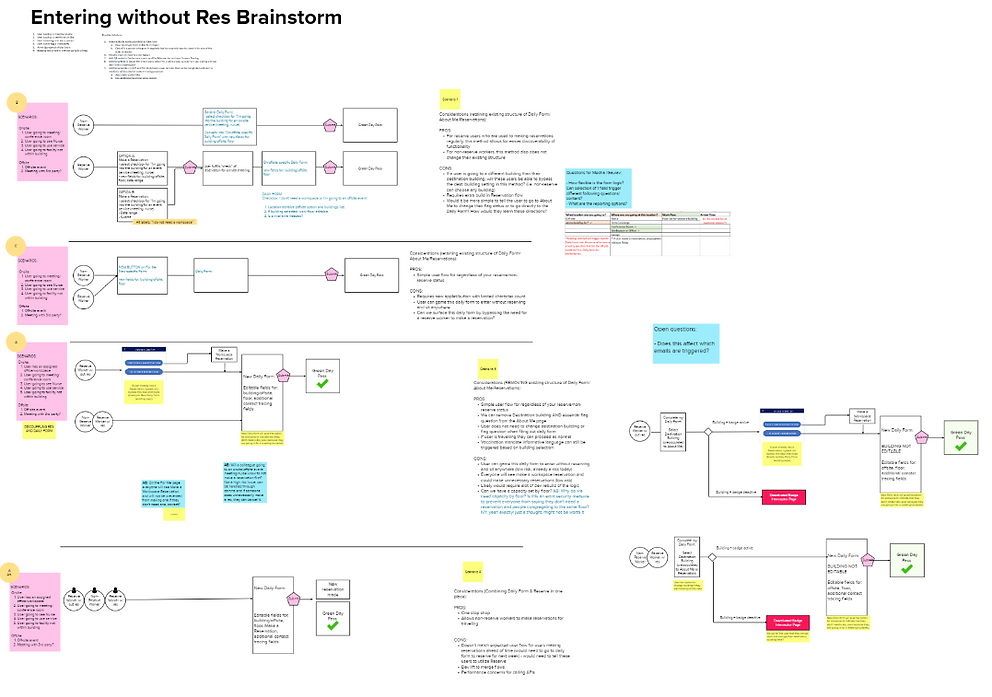
Whiteboarding session to revise user flows for office locations that no longer require reservations to trigger a Day Pass
LESSONS LEARNED
Advocate for the users, even if it means redoing work that was built and implemented only a few months prior
Business needs and requirements will always change, therefore the product must shift to accommodate changing times
Technical limitations - however difficult - should be treated as guidelines for more creative problem solving
If you have access to current or future users, always take advantage to gather first-hand data around product fit and user need
bottom of page